Español
 English


FROM THE DESK OF MICHI C. BRINK
After two decades developing color and teaching nail professionals, the founder of Fantasy Nails explains the thinking behind COLORTECH™: a color consultation system that brings to nail services the expertise that makeup and hair have long considered essential.
About Michi C. Brink. Michi is the founder of Fantasy Nails and the creator of the COLORTECH™ system. She has worked with color in the nail industry for more than twenty years, developing products and teaching nail professionals across Europe and Asia.
COLORTECH™ at a glance. It is the color system for nails that I created at Fantasy Nails. It brings together an education in color theory, a consultation method for choosing color with the client, and a product line in which every shade shows whether its undertone is warm (W) or cool (C).
In conversation with Michi C. Brink
For me, it has always been about color, about developing it, combining it and watching how a single shade can change the whole feeling of a design. After more than twenty years in the nail industry, spent developing products and teaching thousands of nail professionals, it is still the part of my work that fascinates me most. And yet it took me a long time to realize that the way I looked at color was something I had never actually put into words.
It was my students who made me see it. During a class I would choose the shades for a set or a gradient, and sooner or later someone would look up from the table and say, "Michi, I would never have thought of using that color," or simply tell me how much they loved the selection. For years I took it for granted that we were all seeing the same possibilities, because to me the color just looked right. I had not noticed how many small decisions I was making in silence without ever stopping to explain them.

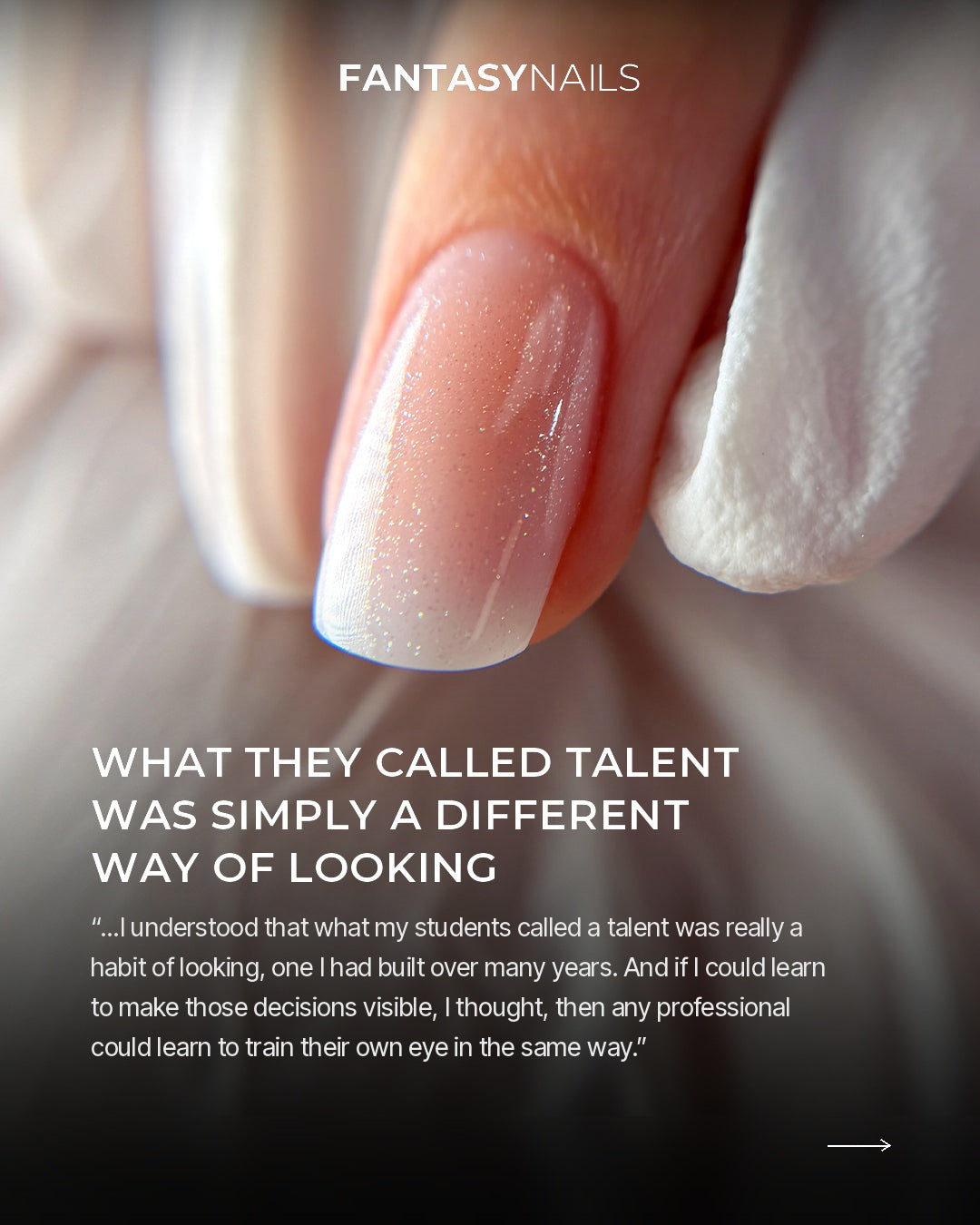
When I finally began to ask myself what I was actually seeing, I understood that what my students called a talent was really a habit of looking, one I had built over many years. I was reading the depth and undertone of the skin, the undertone hidden inside each shade, the way one color behaves when it sits beside another, and the effect the whole combination creates. And if I could learn to make those decisions visible, I thought, then any professional could learn to train their own eye in the same way.

That thought changed the way I listened to the questions I had been hearing in my classes for years. Which color should I choose for this client? Why does a nude that looked so promising suddenly seem dull on the hand? How do I know whether two or three colors will really work together? Color is part of almost every appointment we have, and yet most of us were never really taught what a color does once it sits beside the skin, or why one combination feels balanced while another, made with the same care and the same technique, simply feels off. Somewhere between the art of nail design and the science of color, there was a missing link.
Other areas of beauty closed that gap a long time ago. No makeup artist would choose a foundation without first looking closely at the skin. No colorist would decide on a hair shade without thinking about the person who is going to wear it, because in both crafts getting the color right is simply part of the job. In nails, we have often been content with a color that looks beautiful in the bottle, and of course almost every color can be beautiful. The more interesting question is whether it suits this particular person, their skin and their style. That question is where one service starts to feel very different from another.
This is why I created COLORTECH™: to bring a real understanding of color and undertone into nail services, together with a practical way of consulting the client. I wanted a professional to know not only which color to choose, but also why it works and how to explain that choice to the client with confidence.
Color is chosen on the hand, not from the bottle.
I repeat this to my students again and again, because the moment a shade is applied to a client it is no longer seen on its own. The depth and undertone of the skin change the whole impression. While developing products over the years, I have seen two greys that looked almost identical in their bottles turn out completely different once they were on the skin. Nudes behave in exactly the same way, and the nude that looks beautiful on one client can suddenly appear muddy or heavy on the next. In professional color matching, choosing a nude is never quite enough, because what really matters is choosing the right one for the person in front of you.

The same nude, in warm and in cool
Once you understand these relationships, you actually have more choices rather than fewer, because you can decide whether you want to create harmony, introduce a contrast or bring a design into balance. The aim is never that every client should leave with the same "flattering" color. What the client loves always comes first, and your knowledge is there to help you guide them. The same way of thinking changes how you approach combinations, too. A flower can be painted flawlessly and still feel disconnected from the rest of the design if its colors do not support one another, and a gradient can turn muddy even when the blending has been done with great care. This is why a design so often improves when you rethink the palette rather than the technique. And when a client arrives with an inspiration photo, I always suggest looking first for what it is they love about it, whether that is the mood, the contrast or one small detail. Only then do you adapt the shades to their skin, so that the design stays recognizable while it becomes truly theirs.
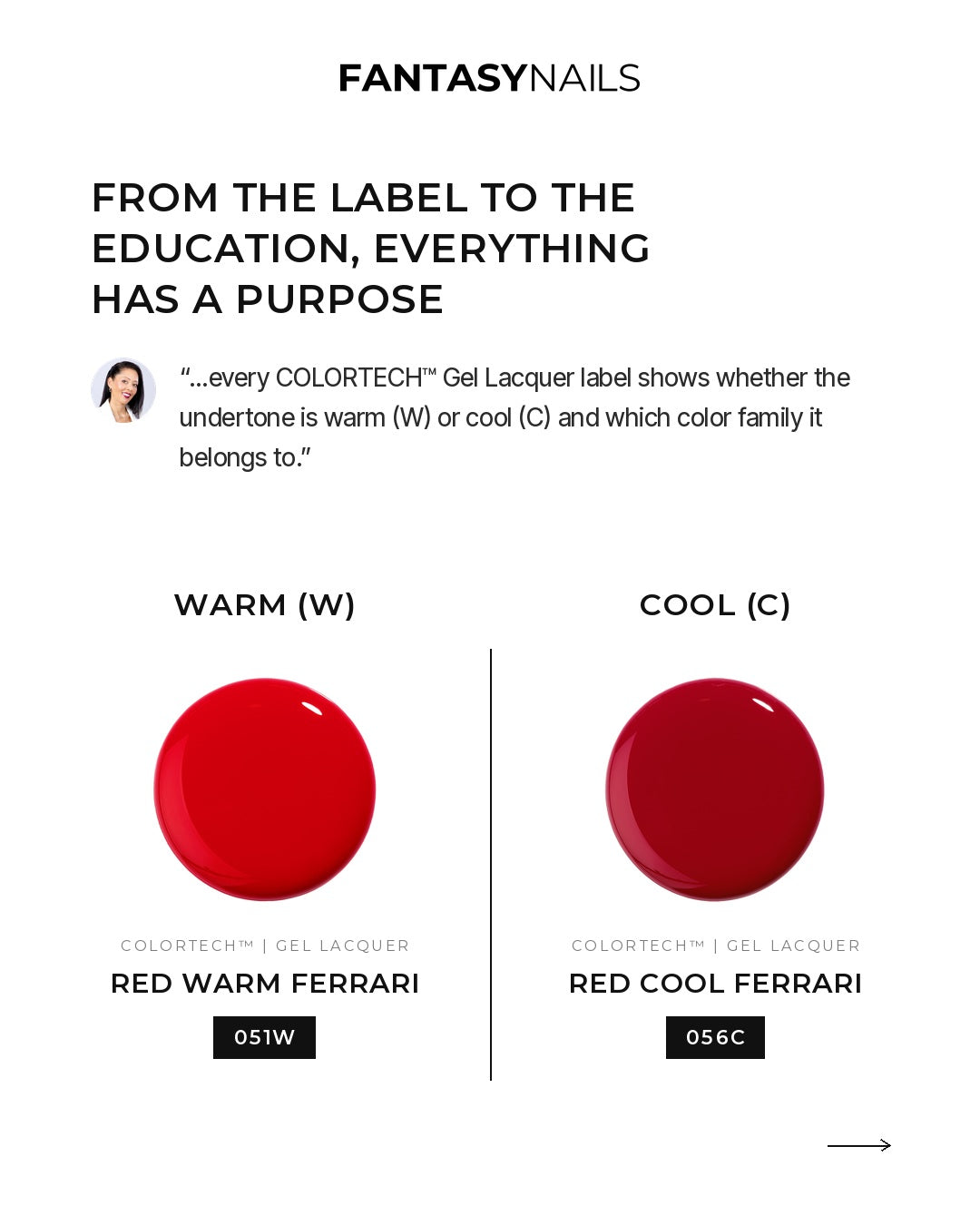
Turning this way of seeing into something other professionals could use meant building it as a complete system, with three parts that support one another. The education comes first, with COLOR THEORY FOUNDATION by COLORTECH™ teaching the principles online and the practical certification giving professionals the chance to apply them on real hands, with guidance. The product line then makes those principles easier to see in daily work, because every COLORTECH™ Gel Lacquer label shows whether the undertone is warm (W) or cool (C) and which color family it belongs to. The same thinking runs through BASELAB™, PROFORM™ and FUSION™. Finally, the method brings all of it to the table, where the conversation with the client actually happens.

The same red, in warm (W) and in cool (C)
That method grew out of LEARN · TEACH · SELL, the framework I use in my own teaching. At the color table it becomes three pillars, ANALYZE, GUIDE and RECOMMEND, which unfold into five steps in a real consultation. To analyze, you read the skin and compare shades directly on the hand. To guide, you listen to what the client wants and walk them through the possibilities. And to recommend, you choose a color and explain clearly why it works. It gives the professional a structure to rely on, and it gives the client a conversation that is easy to follow. The color theory itself does not belong to any one brand, so it can be applied with whichever products you already use, and COLORTECH™ products simply add one more layer of guidance to make the work easier.
For anyone who would like to learn the method, the path begins online with COLOR THEORY FOUNDATION, a self-paced program that can be taken entirely on its own, with any brand, and that leads to a Diploma of Completion. Professionals who wish to offer the COLORTECH™ consultation as a certified service can then continue to the practical certification, for which the online program and its self-assessments are the required first step. There, we practice the method together, I give each professional personal feedback, and everyone completes a final assessment. The first thirteen COLORTECH™ PRO technicians, certified in person in Finland, are already offering this service in their salons.
Over the years, I have seen again and again how the right color can give a client confidence, harmony and balance in a way that feels completely effortless and, at the same time, entirely intentional. That is what I hope every nail professional will be able to offer. When art and color knowledge finally come together, even the choice of one simple shade becomes a more personal experience, both for the professional and for the person sitting across the table.

The online program
COLOR THEORY FOUNDATION by COLORTECH™
Learn to read skin, undertone and color combinations with the same method I teach in the studio. At your own pace, with any brand.
- 36 lessons
- 6 hours of video
- 100% online
- Diploma
It is the first step towards the COLORTECH™ PRO Certification.
Frequently asked questions
What is COLORTECH™?
It is the color system for nails that I created at Fantasy Nails. It brings together an education in color theory, a consultation method with the client, and products classified by warm or cool undertone.
What is color analysis for nails?
Choosing nail colors based on the client's skin depth and undertone, so the shade works on their hand and not only in the bottle. COLORTECH™ turns this into a five-step consultation.
How do I know if a client has a warm or cool undertone?
Reading undertone is one of the first skills taught in COLOR THEORY FOUNDATION by COLORTECH™, step by step and on real hands, because every recommendation that follows is built on it.
What do the W and the C on the labels mean?
W marks a warm undertone and C a cool undertone.
Do I need to use Fantasy Nails products to apply the method?
No. The color theory can be applied with any brand. COLORTECH™ products make the work easier because the undertone is shown on the label.
How long is the online program, and what language is it in?
36 lessons and about 6 hours of video, at your own pace. There is an English version (COLOR THEORY FOUNDATION) and a Spanish version (TEORÍA DEL COLOR).
Does the online course make me a Certified COLORTECH™ PRO?
No. The online course earns a Diploma of Completion. The COLORTECH™ PRO Certification is a separate practical day, and the online course is the required step before applying for it.